Guide
How to get feedback on your resume before you apply, and how to edit with it
Get feedback on your resume before you apply by running three passes: a self-check against the specific job posting, an automated scan for structure and applicant tracking system (ATS) readability, and a read from at least one person who knows your target field. Then turn what you hear into a short, prioritized edit list instead of rewriting the whole document. The templates below cover the first and third passes, and the rest of this guide explains how to sort the feedback once it comes back.
What prompt and message can you copy right now?
These two templates work together. The AI prompt helps you check your resume against the posting, and the message helps you get a useful read from a human reviewer.
Act as a recruiter hiring for [job title] at [company or company type].
Compare my resume below to this job posting.

Job posting:
[Paste full job posting text here]

My resume:
[Paste resume text here, with phone number, email, and street address removed]

1. List the top 5 gaps between my resume and this posting, in order of impact.
2. Flag any bullets that describe duties without a measurable result.
3. For each gap, suggest one rewritten bullet using only experience I have already listed.
4. Note any formatting that might cause problems in an applicant tracking system.
5. Do not invent experience, credentials, or metrics I have not provided.
   If a rewrite needs a number I haven't given, write [number needed] instead.
Before you paste anything into a third-party assistant, strip out your contact details and anything else you would not post publicly, and check that tool’s data settings. The model does not need your phone number to judge your bullets.
Hi [Name],

I'm applying for [job title] roles and would appreciate [amount of time]
of your time on my resume. I've attached it along with one job posting
I'm targeting.

A few questions that would help me most:
- What stands out when you first skim it?
- Which bullets sound like responsibilities rather than results?
- Is anything missing that you'd expect for this type of role?
- What would make you hesitate to interview this candidate?

You don't need to line-edit. A few observations would be genuinely useful.

Thanks,
[Your name]
The AI pass catches structural and keyword gaps quickly. The human reader catches tone, credibility and field-specific norms that software tends to miss.
When should you ask for feedback?
Ask as soon as you have a target job posting and a draft resume tailored to it. A generic resume draws generic advice, which explains why so much resume feedback feels useless. The posting gives every reviewer the same scoring rubric.
A practical sequence looks like this:
- Before your first application: Run the AI prompt and fix the clearest gaps.
- Before a high-priority application: Send the reviewer message to one person in the field, and give them several business days to respond.
- After every major round of edits: Re-run an automated check so you know your new wording didn’t break formatting or drop important keywords.
Timing matters mostly in one direction. Feedback is most useful before you send a batch of applications, because each round of edits then improves everything that follows.
Which feedback sources should you use, and what are the tradeoffs?
Each source is good at something different, and each has blind spots.
| Source | Speed | Best at | Watch out for |
|---|---|---|---|
| Automated graders and ATS checkersTry free resume feedback with Job Match | Minutes | Formatting problems, missing keywords, parse errors | Generic suggestions; no knowledge of your actual work |
| General-purpose AI assistants | Minutes | Comparing your resume to a specific posting, spotting vague bullets, drafting rewrites | Can invent metrics or experience; needs careful prompting and fact-checking |
| Peer in your target field | Days | Industry norms, whether your framing sounds credible | May be too polite; may not know ATS conventions |
| Former manager or mentor | Days | Confirming your scope and results, catching underselling | May remember your work differently than you describe it |
| University or alumni career center | Days to a week | Structured critique, especially for early-career resumes | May not know niche industry expectations |
Combine at least two of these. One automated pass plus one human reader is a reasonable minimum. If you are changing careers or returning after a gap, add a second person who works in the field you are moving into.
What should you ask each reviewer so the feedback is specific?
A request like “let me know what you think” usually gets back “looks good!” Specific questions get specific answers.
For an automated tool or ATS checker: Upload your resume as a PDF and, if the tool accepts one, add the job posting link. Then read the actual parsing output. Check whether your dates, job titles and section headers came through cleanly, and whether the key skills from the posting appear in your resume text.
For an AI assistant: Use the prompt above, and keep the line that forbids invented experience. Without that constraint, AI tools tend to fill gaps with numbers you never gave them. After you get the response, check every suggested rewrite against what you actually did. If a suggestion includes a metric you cannot support, cut it or replace it with a real one.
For a human reviewer: Use the message template. Its four questions steer people toward observations instead of compliments. If you want a read on something particular (a career gap, a short tenure, a title that undersells the job), name it in the message.
How do you decide which feedback to act on when reviewers disagree?
Conflicting feedback is normal. One reviewer calls your summary too long, and another calls it the strongest part. Work through these filters in order.
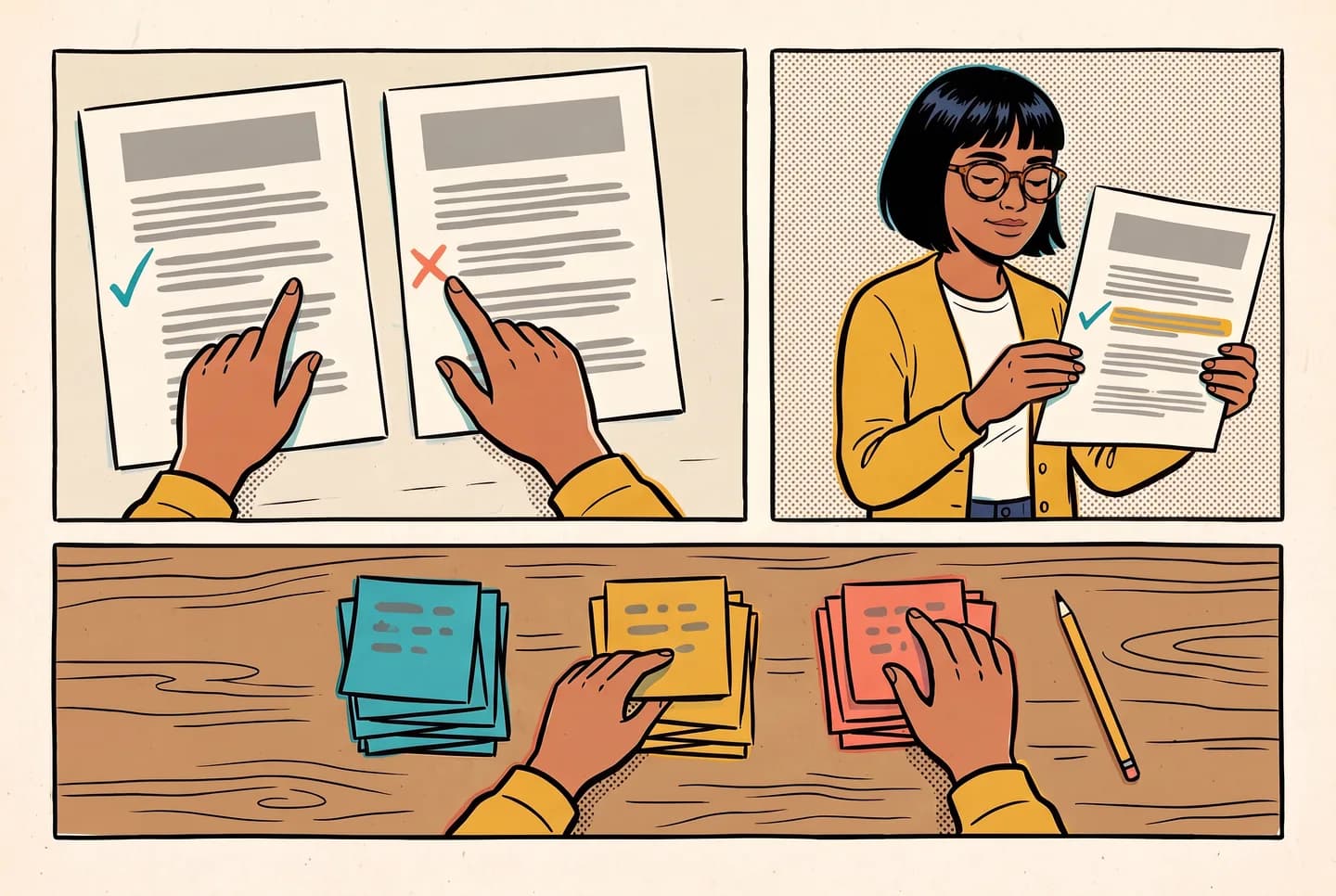
- Check it against the job posting. The posting breaks ties. If the role emphasizes project management and your reviewers split on your project management bullets, keep and strengthen them.
- Weigh closeness to hiring. Someone who has screened resumes for similar roles knows more about what gets a second look than someone in an unrelated field.
- Separate facts from style. Factual feedback (a missing skill, a wrong date, a formatting error that breaks parsing) is almost always worth acting on. Style feedback (summary versus objective, skills in a sidebar) is more subjective, so default to the format that parses cleanly in an ATS scan.
- Look for overlap. When two independent reviewers stumble on the same bullet, treat that as a strong signal even if they suggest different fixes.
Write every note down, tag it as structural, factual or stylistic, and handle the structural and factual items first.
What should you edit first after getting feedback?
Resist the urge to start over. Work through this checklist in order.
- Tailor to the posting. Go through the posting’s requirements one at a time. For each skill or qualification it names, confirm your resume shows evidence of it. If you have the experience and left it out, add a bullet. If you don’t have it, leave it off.
- Quantify vague bullets. Find bullets that describe a responsibility without an outcome. Here is an illustrative pattern with blank fields for your own details:
- Before
- “Managed social media accounts.”
- After
- “Managed [number] social media accounts, growing followers from [starting count] to [ending count] over [time period].”
- Fix formatting that breaks ATS parsing. Common culprits include multi-column layouts, text inside images, skill-bar graphics, symbols in headers, contact information placed below the top of the page, and nonstandard date formats. A single-column layout with standard section headers (Experience, Education, Skills) is the safest starting point.
- Verify dates, titles and claims. Every job title, company name, start date and end date should match what an employer would find if they verified it. Mismatches can raise questions later in a hiring process, even when they come from an honest mistake. Check these details against offer letters, pay stubs or other records before you submit.
- Cut filler. Once the substantive edits are done, read the resume again and remove anything that doesn’t support this specific application. Outdated skills, unrelated early jobs and unsupported claims like “team player” are usually safe to cut.
What should you check right before you submit?
Run one last pass before you hit apply.
- Read the first three bullets of your most recent role out loud. If they sound like a job description instead of a record of what you did, revise them.
- Check the file format. Submit a PDF unless the application asks for a Word document, since PDFs hold their formatting more reliably.
- Confirm your contact information. A typo in your email address is the one error a strong resume cannot recover from.
- Run the automated scan again. Your edits may have introduced new parsing issues, and this is the cheapest moment to catch them.
Where does Checkr Personal fit in?
The process in this guide works with any set of tools, but it involves a lot of copying and pasting: your resume into an AI assistant, the posting next to it, the feedback into a document, and then the same routine for the next posting. Checkr Personal keeps those steps in one place, from finding a role to previewing your own background check.
- Job matches curate postings for you, so the role you tailor your resume to starts in the same place as your resume.
- Resume feedback gives line-by-line notes and fixes ranked by priority for the role you’re targeting.
- Checkr Coach (coming soon) will help you prepare for interviews once your resume starts getting responses.
- A background check on yourself lets you preview what employers may see, such as criminal and registry records, so you can spot a potential inaccuracy on your report and correct it before they run their own.
Job matches and resume feedback are free. Whatever tools you use, treat their feedback as one input alongside your human reviewers.
Common questions
Quick answers
How do I get feedback on my resume before I apply?
Run three passes. First, check your resume against the specific job posting. Second, use an automated scan to check structure and applicant tracking system (ATS) readability. Third, ask at least one person who knows your target field to read it. Then turn the feedback into a short, prioritized edit list instead of rewriting the whole document.
Who should I ask to review my resume, and what should I ask them?
Combine at least two sources, such as one automated check and one human reader in your target field. Former managers, mentors and career centers can help. Instead of asking what they think, ask what stands out on a skim, which bullets sound like responsibilities rather than results, what is missing and what would make them hesitate to interview you.
Can I use AI to get useful resume feedback without it inventing things?
Yes, if you prompt it carefully. Ask it to compare your resume to a specific job posting, and include a line forbidding invented experience, credentials or metrics, with [number needed] as a placeholder instead. Then check every suggested rewrite against what you actually did, and cut any metric you cannot support. Remove contact details first.
How do I decide which resume feedback to act on when reviewers disagree?
Work through four filters in order. Use the job posting to break ties. Give more weight to reviewers who have screened resumes for similar roles. Act on factual feedback, such as a missing skill or wrong date, before style preferences. Treat it as a strong signal when two independent reviewers stumble on the same bullet.
What should I edit first after getting resume feedback?
Start by tailoring your resume to the job posting, confirming it shows evidence of each skill the posting names. Next, quantify vague bullets with numbers from your own work. Then fix formatting that breaks ATS parsing, verify dates, titles and claims against your records, and finally cut filler that does not support this application.